How to Get Homework Done Faster: 15 Study Tips That Actually Work
In 9th grade I timed myself for a week because I was convinced homework hated me. Turns out a "one hour" worksheet was really 25 minutes of actual work stretched across two and a half hours of me checking my phone, reheating food, and starting the hard question five separate times.
That week kind of broke my brain in a good way. I wasn't slow. I was leaking time. So I started fixing the leaks one at a time, and my afternoons got a lot shorter. This is the exact list of things that worked, written the way I'd explain it to a friend who's drowning in assignments and wants to know how to get homework done faster without becoming a different person.
Quick promise: none of this is "just try harder." Trying harder was never my problem. Better habits were the whole game. Here's what changed.
Quick Answer: How to Get Homework Done Faster
Getting homework done faster comes down to cutting wasted time. Prep your stuff before you sit down, put your phone in another room, do the hardest subject first while your brain is fresh, work on one task at a time with a timer, and get a clear step-by-step explanation the second you're stuck instead of staring at the page. The habits matter way more than how smart you are.
What's in this guide
- Get everything ready before you start
- Put your phone away and remove distractions
- Start with the hardest assignment first
- Stop multitasking while studying
- Break large assignments into smaller tasks
- Don't stay stuck on one problem too long
- Create a better study environment
- Stop chasing perfection
- Use homework resources the right way
- Set clear deadlines
- Get enough sleep for better focus
- Keep track of assignments
- Take effective study breaks
- Reward yourself and stay motivated
- Find the study method that works for you
1. Get everything ready before you start
This is the most boring tip on the list and it saved me the most time, so I'm putting it first on purpose. I used to sit down to do homework, then get up for my charger. Then a snack. Then the notebook I actually needed. Then a pen that wrote. Each trip felt free, but every time I stood up my focus reset to zero.
Now I spend one minute setting up before I start. Laptop charged, water bottle full, every book and worksheet on the desk, phone in the other room. When there's nothing to get up for, you don't get up. Honestly this one habit does more for homework organization and a smooth homework routine than any app I've tried.
2. Put your phone away and remove distractions
Here's my hot take: your phone is a bigger reason homework takes forever than any subject you've ever had. When my phone sits next to my notebook, I check it without deciding to. A buzz, a glance, "just one reply," and suddenly it's ten minutes later and I've lost my train of thought completely.
The thing that fixed it wasn't willpower, it was distance. My phone goes in a different room, face down, on silent. Not next to me on silent. A different room. If it's an arm away, part of your brain keeps waiting for it. If you do homework on a laptop, close every tab that isn't the assignment. That's basically the whole secret to how to focus while studying: remove the distraction before it can grab you.
3. Start with the hardest assignment first
For a long time I did the easy stuff first because checking things off felt good. Bad move. By the time I reached the hard assignment I was already tired, so the hard thing felt even harder, so I put it off, and the whole night dragged into the evening.
When I flipped it and did the scariest subject first, while I still had energy, everything after it felt downhill. There's also this quiet stress that sits on you all night when you know the big assignment is still waiting. Finishing it early kills that. It's one of the simplest time management for students tricks and it completely changed how my afternoons feel.
4. Stop multitasking while studying
I genuinely believed I was good at multitasking. I'd have homework open, a show playing, and a group chat going, all at once. What I was actually doing was three things badly and slowly. Every time you switch, your brain pays a little tax to reload what it was doing, and that tax adds up to real minutes.
Doing one thing at a time felt weirdly boring at first. It's also just faster. Pick one assignment, put everything else out of sight, and stay on it until it's done or the timer ends. When a random thought pops up ("did I reply to that?"), I write it on a sticky note and get back to work. That single change is a big part of building study habits that stick.
5. Break large assignments into smaller tasks
A giant task like "write a 5 page essay" used to freeze me completely. My brain would look at that wall and quietly decide to handle it later, which meant never. What finally worked was chopping the wall into bricks. Pick a topic. Write the thesis. Outline the points. Find quotes. Write the intro. Now there's no monster assignment, just a small next thing I can actually start.
I keep a rough checklist for anything with more than a couple of steps. Crossing off little pieces builds momentum, and momentum is what drags you through the parts you don't want to do. This one homework productivity habit works for essays, study guides, lab reports, all of it.
6. Don't stay stuck on one problem too long
This was my worst habit by far. I'd read the same hard question over and over, sure that if I stared long enough it would suddenly click. It almost never clicked. Fifteen minutes frozen on one problem can wreck an entire schedule and your motivation with it.
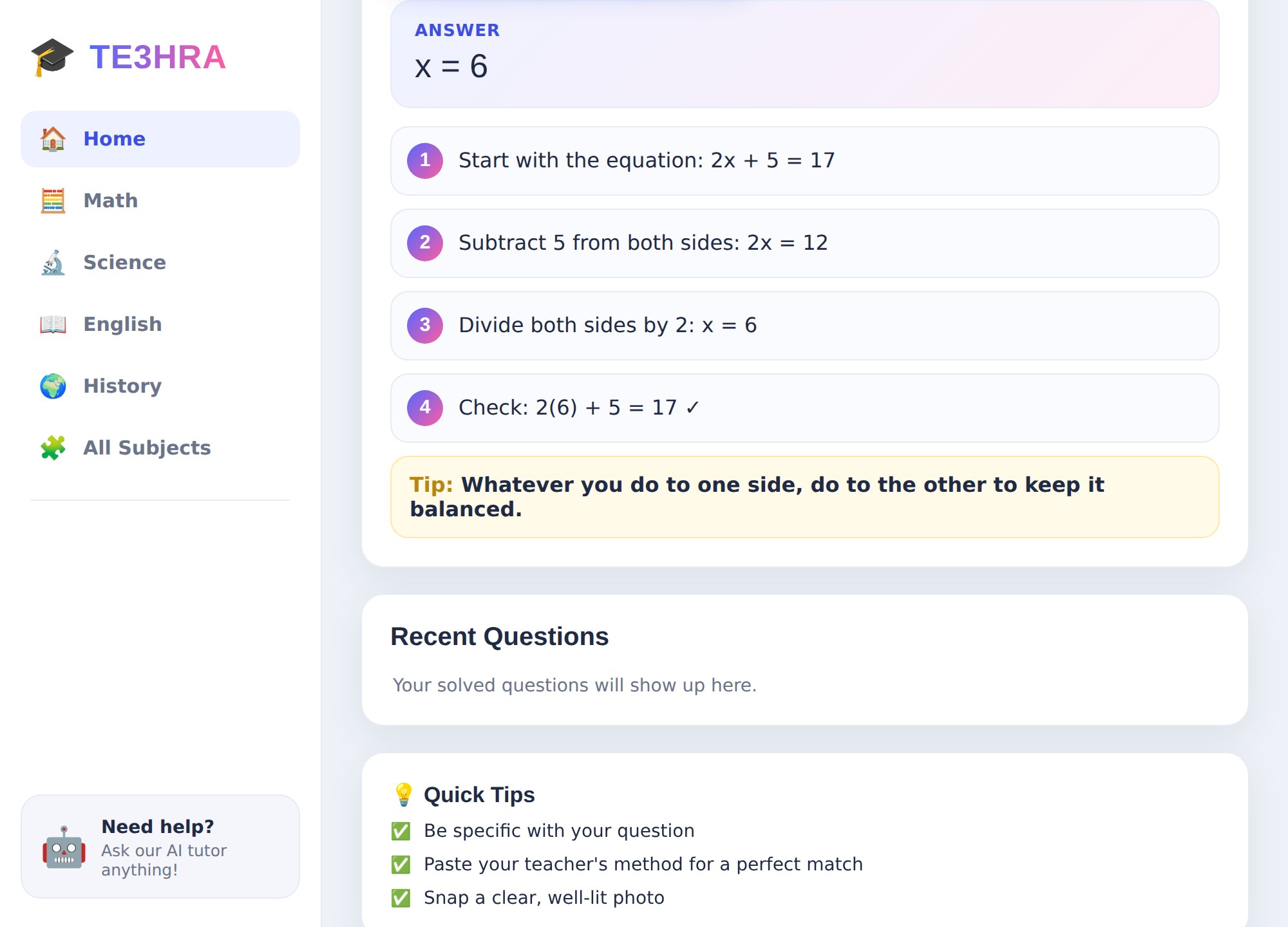
Now I have a rule. If I'm genuinely stuck for about five minutes, I stop grinding and go find a clear explanation of the steps. Here's the specific story of how I stumbled into the thing I use now. Last year I had a geometry teacher, Mr. Alvarez, who was strict in a very particular way. He wanted every proof written in his exact order, and I kept getting the right answer while losing half the marks for "not showing work properly." I was venting about it in my grade's group chat at like 10 p.m., and a girl a year above me typed back, "just use te3hra, you paste an example of how the teacher wants it and it copies that." I was skeptical, but I was also stuck on a proof, so I pasted one of Mr. Alvarez's own example problems into it and asked it to solve a new one the same way. It laid the steps out in almost his exact format. I got full marks on "showing work" that week for the first time in a while. That's the actual reason a step-by-step homework helper earned a spot in my routine. It didn't do my thinking for me, it just got me unstuck and showed the method so I could do the next one myself.
7. Create a better study environment
Doing homework in bed was a trap for me. It felt cozy and my focus was garbage and I got sleepy in about twenty minutes. Moving to an actual desk with decent light changed my concentration without me trying any harder.
You don't need some aesthetic setup from Pinterest. You need a spot your brain learns to link with focus. Good light, a clear surface, a chair that keeps you upright, and as little noise as you can get. Sitting in the same place every day quietly trains a study routine, so you slip into focus mode faster each time you sit down.
8. Stop chasing perfection
Perfectionism looks like effort, but for me it was just slow procrastination wearing a disguise. I'd rewrite one sentence five times or redo a diagram because it wasn't "clean." Meanwhile the clock ran and nothing was actually finished.
Most homework needs to be done and correct, not gallery-ready. I do my honest best on the first pass, finish the whole thing, and only go back to polish if there's time left. Letting go of perfect gave me back a shocking amount of time, and my grades didn't drop at all. That one surprised me.
9. Use homework resources the right way
There's a real difference between using a resource to learn and using one to copy. Copying an answer gets you through tonight and leaves you just as lost on the test. Using a resource to understand the steps makes you faster for good, because you pick up the pattern instead of the single answer.
The best homework help websites and study techniques explain why, not just what. When I hit something I don't get, I look for the method, then I try the next problem on my own to make sure it actually stuck. Used like that, a good homework helper is basically a patient tutor that never gets annoyed at you. I put a quick comparison of a few below.
10. Set clear deadlines
Work stretches to fill whatever time you give it. When I told myself "I'll do homework tonight," it somehow ate the entire night. When I said "math is done by 5:15, then I stop," I actually hit it. Vague plans are slow. Specific ones are fast.
So I give each task a mini deadline and, when I can, a timer I can see. A countdown creates this gentle pressure that keeps me from drifting off. It's a tiny time management for students habit that turns a shapeless evening into a set of short races I can actually win.
11. Get enough sleep for better focus
This felt backwards until I tested it. Staying up late to grind homework made me slower the next day, so I was basically borrowing time from tomorrow at a terrible interest rate. Tired me reads slower, does worse math, and gets stuck more.
A rested brain reads faster and gets stuck less, which means homework takes less time. Protecting your sleep is a real student productivity move, not a reward you unlock after the work. If homework keeps pushing you way past a decent bedtime, that's a signal your system needs fixing, which is what this whole list is for.
12. Keep track of assignments
I used to "remember" my homework, which really meant forgetting it until it was almost late and then panic-doing it. Panic is slow and it feels awful. The fix was boring but it worked: write every assignment in one place, a planner or a notes app, whatever you'll actually open.
When everything lives in one list with due dates, you can plan ahead, spread big projects out over a few days, and stop getting ambushed at 10 p.m. by something you forgot. Good homework organization like this quietly removes a ton of stressed, wasted time and makes the whole week calmer.
13. Take effective study breaks
Powering through for two hours straight sounds productive, but my focus fell off a cliff after about half an hour. The fix wasn't skipping breaks, it was planning them. I work in blocks of roughly 25 minutes, then take a real 5 minute break where I stand up, stretch, and get water.
The important part is that the break has a set length. "I'll take a quick break" becomes an hour on your phone. A timed break keeps you honest. Structured breaks are one of the most reliable study techniques out there because they keep your brain fresh instead of running it into the ground.
14. Reward yourself and stay motivated
Motivation gets a lot easier when there's a small thing waiting on the other side. I started giving myself little rewards for finishing tasks. A snack after math, an episode once everything's done, a walk after a big project. It sounds childish and it works, because your brain likes a clear payoff.
Keep the rewards small and keep them after the work, not during. An episode, not the whole season. Pairing effort with a little reward builds study habits that actually last, which is what makes homework stop feeling like a nightly fight.
15. Find the study method that works for you
Here's the honest truth nobody tells you: the "perfect" study method is just the one you'll actually keep doing. I tried a pile of fancy systems and quit almost all of them. What stuck was simple. Prep my space, phone gone, hardest thing first, timed blocks, get unstuck fast.
Try a few things for a week or two. Keep whatever makes homework feel lighter and drop whatever feels like a chore. Once you find your own study routine, finishing faster stops being a lucky night and just becomes how you work. That's the actual goal here.
A quick comparison of homework resources
People always ask what I actually use, so here's an honest rundown. Every one of these is good at something different, and none of them replaces thinking for yourself.
| Tool | Best for | Step-by-step | Helps you learn | Free |
|---|---|---|---|---|
| Khan Academy | Learning a whole topic with videos | Yes, in lessons | Strong | Yes |
| Photomath | Scanning and solving math problems | Yes | Okay | Free + paid |
| Quizlet | Memorizing terms with flashcards | Limited | Some | Free + paid |
| Te3hra | Getting a specific problem shown your teacher's way | Yes | Strong | Yes |
| Quick facts and definitions | Varies | Depends | Yes |
If I'm memorizing vocab, Quizlet. Learning a new topic from scratch, Khan Academy. Stuck on one specific problem that has to be shown a certain way, that's when I open te3hra. Use whatever fits the actual thing you're stuck on.
Frequently asked questions about getting homework done faster
How can I get homework done faster?
Prep your materials before you sit down, put your phone in another room, work on one assignment at a time with a timer, and get a clear step-by-step explanation the moment you're stuck. Habit changes save more time than working harder.
Why does homework take me so long?
Usually it isn't that the work is impossible, it's lost time. Phone checks, multitasking, disorganization, and freezing on one problem quietly add up. Plug those leaks and homework gets faster.
How do I stop procrastinating on homework?
Make starting tiny. Promise yourself just five minutes on the first small step. Starting is the hard part, and once you're moving you usually keep going. Hiding your phone first makes it way easier.
What is the best homework routine for students?
A simple one you'll repeat: same time, same quiet spot, phone away, hardest subject first, short breaks between tasks. Routines work because they remove the "when and how do I start" decision.
Does listening to music help with homework?
Depends on the task. Calm music without lyrics can help with repetitive stuff. Songs with words usually hurt reading and writing. If you keep re-reading the same line, try silence.
Are homework helpers useful?
They are when they explain the steps instead of just handing over an answer. A good homework helper shows you how to reach the solution so you can do the next one yourself.
How can I focus better while studying?
Kill the distraction before it starts. Phone in another room, tabs closed, one task on screen. Work in blocks of about 25 minutes with short breaks so your focus has a finish line.
How can I finish homework in one hour?
List every task, do the hardest first, put a timer on each one, and don't let yourself freeze on any single problem for more than a few minutes. Getting fast help when stuck is what keeps the hour on track.
What are the best study techniques for homework?
Time-blocking, single-tasking, breaking big work into small steps, and active recall. The best technique is honestly the one you'll actually keep using, so keep it simple.
How can students improve homework productivity?
Fix the system, not the effort. Prep materials first, cut distractions, keep assignments in one list, and use resources that teach the steps. Better habits beat longer hours every time.
Final thoughts
If you remember one thing from all this, make it this: your homework probably isn't slow because you're bad at it. It's slow because of small, fixable leaks. The phone, the multitasking, the freezing on one question, the messy planning. Back in 9th grade I really thought every assignment was just impossible. It wasn't. I was losing time in a dozen tiny ways I never noticed.
Pick two or three of these and try them tonight. Prep your space, put the phone in another room, and get unstuck fast when you hit a wall. Do that for a week and you'll feel it. More free time, less stress, and homework that fits inside your evening instead of eating the whole thing.